
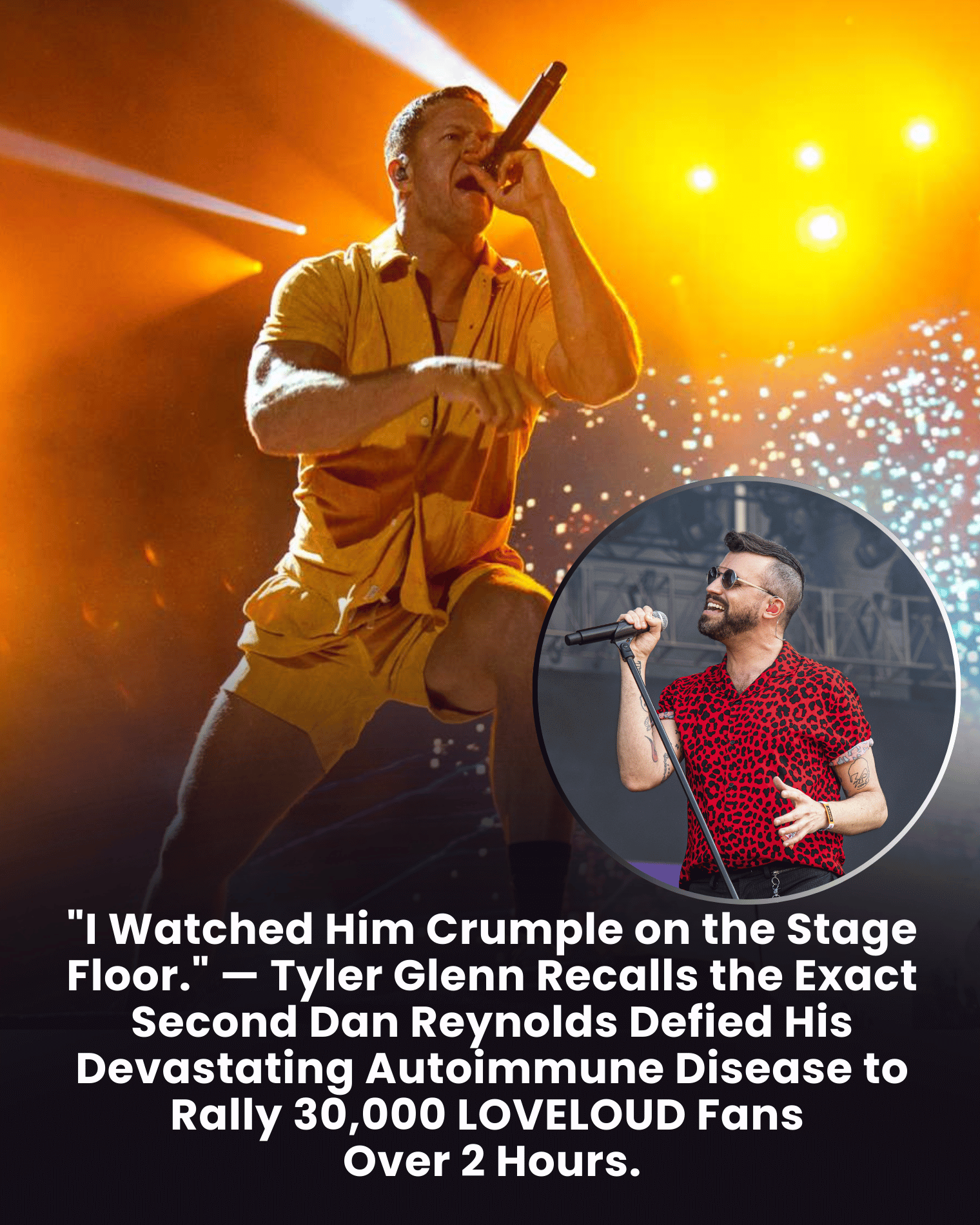
During one of the most emotional nights at the LOVELOUD Festival, a moment unfolded on stage that left everyone backstage holding their breath. Among those watching closely was Tyler Glenn, who knew something the massive crowd of fans did not: the man commanding the stage, Dan Reynolds, was quietly battling a painful autoimmune condition that could strike at any moment.
Reynolds, the frontman of Imagine Dragons, has long been open about his struggle with Ankylosing Spondylitis. The condition causes inflammation in the spine and joints, leading to severe stiffness, chronic pain, and in some cases the gradual fusion of vertebrae. For a performer whose concerts demand relentless energy, jumping, and intense physical movement, the illness can make even standing upright a challenge during flare-ups.
That night at LOVELOUD, the stakes were higher than a typical concert. Reynolds founded the festival to support LGBTQ+ youth, particularly those struggling with identity and belonging in conservative communities. Tens of thousands of fans had gathered—many of them young people who saw Reynolds as a rare ally willing to use his platform to speak openly about acceptance and mental health.
Backstage, Glenn watched the performance unfold with a mixture of pride and concern. As the show built toward one of its biggest musical crescendos, the energy in the venue surged. The crowd roared as Reynolds pushed his voice harder, feeding off the emotion of the night.
Then suddenly, it happened.
Mid-song, Reynolds dropped to his knees.
From Glenn's vantage point offstage, the moment felt terrifyingly real. He knew the disease could trigger sudden waves of pain that made movement nearly impossible. For a split second, Glenn believed the performance might have to stop. His instinct was to signal medics immediately.
But before anyone could react, Reynolds reached for the microphone stand.
His face was slick with sweat, his expression twisted in visible pain, yet he refused to remain on the floor. Slowly, using the stand for leverage, he forced himself upright again. The crowd—unaware of the internal battle happening inside his body—continued cheering as the music thundered around him.
Once standing, Reynolds did something that turned the moment into legend.
He struck his chest with his fist, looked out at the sea of fans in front of him, and unleashed a massive vocal roar that cut through the arena. The sound carried across the crowd of more than 30,000 people, electrifying the entire festival. What could have been a moment of collapse instead became a declaration of resilience.
For Glenn, watching from the side of the stage, it was unforgettable. He had seen the private struggles Reynolds endured to keep performing despite the disease. But seeing him push through the pain in front of thousands—while singing for the very community the festival was created to protect—felt profoundly powerful.
The performance continued for nearly two hours.
By the end of the night, the audience had witnessed more than just a concert. They had seen a performer refuse to let his own body silence him. Through pain, exhaustion, and determination, Reynolds turned a moment of vulnerability into a message of strength.
For Glenn, that instant when Reynolds rose from his knees remains frozen in memory—a reminder that sometimes the most powerful performances are not about perfect notes or flawless choreography, but about the courage to stand back up when your body tells you to fall. 🎤